
What an exciting collaboration this is. When artists come together to form a supergroup like this, the results aren't always as amazing as expected. In the track below, they really are. You can hear the workings of all three artists weaving together with lush results. I'm now dreaming of an album by this lot, maybe with Flying Lotus thrown in for good measure.
18 March 2011


4 February 2011
The Future of the Gaming Industry
Last Wednesday’s discussion at the Institute of Contemporary Arts, The Future of the Gaming Industry, left me feeling dismayed rather than excited about what to expect from my beloved pastime. According to the industry experts speaking at the event it would seem that ‘mobile’ and ‘social’ are the buzzwords for the foreseeable future. Mobile gaming and Facebook gaming are all well and good for the casual, passive gamer but where does this leave those who crave technical innovation and engrossing narrative experiences?
According to Nicholas Lovell, founder of the blog Gamesbrief, the industry is going to split into three distinctive types of games – dominant triple-A blockbusters such as the Call of Duty series, persistent world subscription-based games like World of Warcraft and independently developed games. He said we are now getting to the stage where only a “few big players can experiment in the medium” with huge financial backing. Judging by the condition of the games currently being released by these major players, there’s cause for concern.
Take the aforementioned Call of Duty as the prime example. The last two editions of the franchise - Modern Warfare 2 in 2009 and Black Ops last year – were each unveiled to a media frenzy of a magnitude not before seen in the industry. But why? They are mindless, unoriginal and built on technically flawed foundations and aging technology (check out my scathing review of Black Ops). Their target market, however, is casual gamers who play solely online for the social experience it offers. It would seem this rapidly expanding audience do not care about such trivialities as whether a gun recoils in the correct way, or whether the game’s engine is horribly outdated. What they want is to be able to turn on their games console, pick up their controller and shoot people whilst having a laugh with their mates. This is the market the vast majority of publishers will focus on, and where the big money will be spent, inevitably alienating smaller developers with bigger ideas.
Mobile gaming is advancing technically and becoming more sophisticated in content. The market for portability is ever-present, and with Sony and Nintendo focusing more on the area and developers of games for smartphones offering up an increasing number of exciting and reputable titles, it seems this industry cannot fail to grow rapidly.
Going back to social gaming, Tom Chatfield, author of Fun Inc.: Why games are the 21st Century's most serious business, said “Facebook is going to generate hundreds of millions of dollars” for those who develop games for the site. He added that we are living in a “value generation” where the “quality of attention” offered by games, now accessible enough for pretty much everyone, “is of a much higher value than other media”. Games based on simple, proven mechanics, such as Farmville and clones of Scrabble have grabbed the attention of an incredible range and volume of Facebook users. It was mentioned that half of the 600 millions Facebook users have installed some form of game app, leading developer Michael Acton-Smith to believe that in the future the question won’t be “do you play games?”, but “what games do you play?”
According to Nicholas Lovell, founder of the blog Gamesbrief, the industry is going to split into three distinctive types of games – dominant triple-A blockbusters such as the Call of Duty series, persistent world subscription-based games like World of Warcraft and independently developed games. He said we are now getting to the stage where only a “few big players can experiment in the medium” with huge financial backing. Judging by the condition of the games currently being released by these major players, there’s cause for concern.
Take the aforementioned Call of Duty as the prime example. The last two editions of the franchise - Modern Warfare 2 in 2009 and Black Ops last year – were each unveiled to a media frenzy of a magnitude not before seen in the industry. But why? They are mindless, unoriginal and built on technically flawed foundations and aging technology (check out my scathing review of Black Ops). Their target market, however, is casual gamers who play solely online for the social experience it offers. It would seem this rapidly expanding audience do not care about such trivialities as whether a gun recoils in the correct way, or whether the game’s engine is horribly outdated. What they want is to be able to turn on their games console, pick up their controller and shoot people whilst having a laugh with their mates. This is the market the vast majority of publishers will focus on, and where the big money will be spent, inevitably alienating smaller developers with bigger ideas.
Mobile gaming is advancing technically and becoming more sophisticated in content. The market for portability is ever-present, and with Sony and Nintendo focusing more on the area and developers of games for smartphones offering up an increasing number of exciting and reputable titles, it seems this industry cannot fail to grow rapidly.
Going back to social gaming, Tom Chatfield, author of Fun Inc.: Why games are the 21st Century's most serious business, said “Facebook is going to generate hundreds of millions of dollars” for those who develop games for the site. He added that we are living in a “value generation” where the “quality of attention” offered by games, now accessible enough for pretty much everyone, “is of a much higher value than other media”. Games based on simple, proven mechanics, such as Farmville and clones of Scrabble have grabbed the attention of an incredible range and volume of Facebook users. It was mentioned that half of the 600 millions Facebook users have installed some form of game app, leading developer Michael Acton-Smith to believe that in the future the question won’t be “do you play games?”, but “what games do you play?”
18 November 2010
Call of Duty: Black Ops (Single-player) review
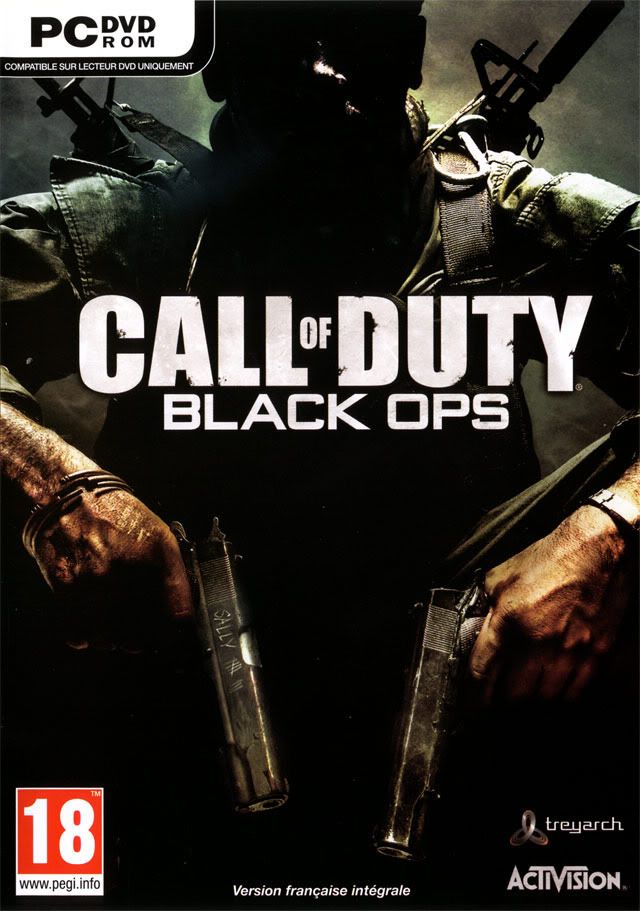
Now we arrive at Black Ops, which for hardcore gamers with a true eye for quality has turned out to be pretty much an irrelevant title. With the enormous sums of money Activision must be making from the series, using the same tired engine for the fourth time in a row is an indicator of their blatant greed and agenda for quantity over quality. Not only that, Black Ops somehow manages to be worse than it's predecessors both graphically and performance-wise!
First impressions then are that I'm playing a game from 2004, but I can see past that. You only have to look as far back as Amnesia: The Dark Descent to see that a game can use old tech but be brilliant. It's after about 15 minutes of play, however, that I begin to realise that Call of Duty Black Ops is not only severely flawed, but fundamentally broken. I'm referring to the fact that I had to restart the game three times as the shaky set piece system failed to initiate the next sequence, even after I reloaded from the last checkpoint. When a game relies so much on this kind of scripting, the minimum requirement is that it works. Fortunately it didn't happen again after the nightmare start. What I did experience consistently however was such nonsense as having to progress a certain distance before enemies stopped respawning, an inexcusable flaw that completely shatters any illusion that could have otherwise been built up with better coding.
While the old school run-and-gun gameplay is generally uninspired, there are some enjoyable moments. Rappelling down a building before smashing through a window and unleashing hell in super-slow motion is an example of the more engaging moments that are all too rare. For the most part, you'll be blasting your way through the levels with a feeling that you're wasting your time. I will mention however that Black Ops possesses the almost unheard of attribute of gradual improvement as the game progresses.
The feel of the weaponry has to be the worst I have ever come across in a shooter. The guns have absolutely no recoil - try emptying a clip from an assault rifle and you'll see almost no movement. They all sound like pea shooters and there is little to distinguish them. The AI is rudimentary, with no real improvement evident over even the first Call of Duty from 2003. All of which of course makes for extremely dull shootouts.
Black Ops' soundtrack is a varied and strange mixture of the cringe worthy, brave and excellent. Sometimes a godawful dance beat is introduced that does its best to detract from any semblance of enjoyment you might be having. The game's finale, however, is enhanced by a well-fitting track and when the Rolling Stones' Sympathy For The Devil creeps in during a boat level, you'll forget for a couple of minutes how dull the combat is.
There's a story in there too. It's actually slightly more interesting than you'd expect from a game of this type, though I never found myself at all engrossed. Killing Fidel Castro is this edition's Daily Mail-baiting version of the 'airport level', which again had about as much emotional impact on me as your average soap opera.
If you're wondering why I've not accounted for the multiplayer in this review, it's because I don't see the point in playing it, and didn't. There are plenty of better ways to get your kicks online, with the previously mentioned Bad Company 2 currently leading the way. Call of Duty is however a much more accessible series that is now designed for casual gamers and console kids. Be warned; this will be reflected by the depressingly low maturity levels of the community.
Despite all this, most journos have been inexplicably generous in their reviews, with many handing out scores well into the 90s. With the game's Metacritic score currently at 85/100 for critic reviews with a user score of 3.8/10, we at least know where a chunk of the development budget went...
4/10
Subscribe to:
Posts (Atom)